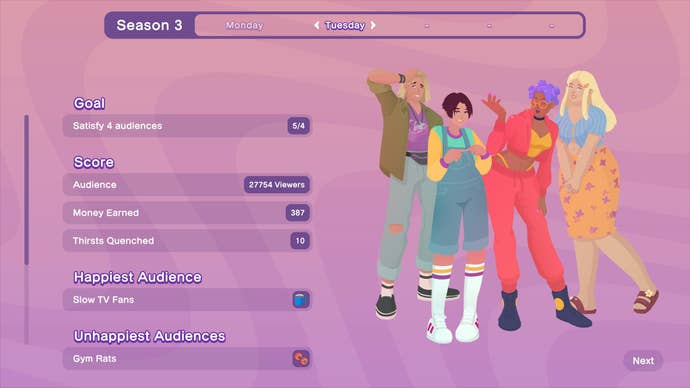
Each audience group has a HUD icon that must be filled up by shooting footage that scratches their itches.
There are callbacks to many reality TV shows in The Crush House, more than I can pin down.
The characters hold up a mirror to everybody from Nasty Nick to the Kardashians.

But I’m not sure this game is about nostalgia for reality TV, in practice.
Content, coursing through the pipes of the Success Slide.
Content, dripping with an audible glug-glug into the audience icons on your feed.

Filming Content isn’t the same as filming people.
Reality TV needs stars, powerful egos with that boutique blend of photogenic and sympathetic and unbearable.
The Content industry doesn’t need stars, though it may sporadically reward them.

And that’s sort of how it works initially.
You’ll memorise the layout in no time.
It’s an inglorious, sordid living.

Still, there’s an art to it.
But as you unlock more audiences, the mathematics of Content overtake the crafting of drama.
Some of the viewerships make no sense at all.
The Pharologists are endlessly curious about the lighthouse.
The Foodies hanker for imagery of posh kitchenware and performative pot-stirring.
You might call this a failure of the game’s simulation of reality TV.
The Crush House is Debord’s “vicious circle of isolation” in miniature.
Having taught you to behave like a drone, The Crush House turns the screws.
It’s a surprisingly difficult experience, with a constipated mid-game.
I only ever earned enough to buy a couple of cheap items or a single prestige item per season.
The challenge is to do your job well enough to survive, while pursuing somethingotherthan your job.
And then there’s what happens between episodes.
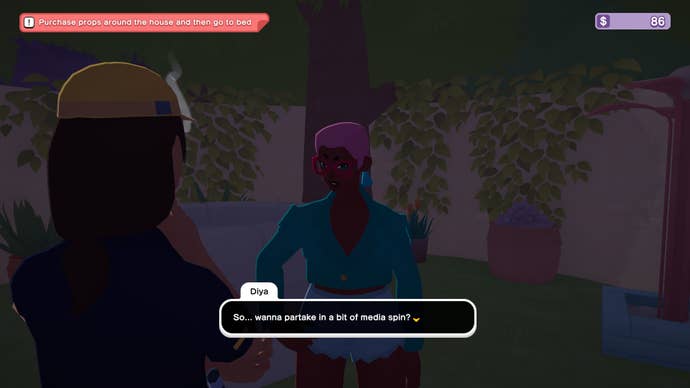
The game gives you the option of turning requests down, even scornfully.
But helping other people is helpful for you.
It takesenormousinsight to make something this ugly.
