So here it is.
All 8760-odd words of it.
for a lot of the questions I ask below.
This interview has been lightly edited for clarity.
RPS: So you’ve left Firaxis!
How does that feel?

Jake Solomon:I left on Friday, so this is my third work day unemployed.
Yeah, it’s surreal, right?
Obviously, I’d been there a long time.
Everybody was really nice.
Sid got up and said some nice things.
So it was tough.
It was tough to leave.
It’s such a great…
I mean, I still love it.
It’s exciting, but, you know, a little terrifying.
You didn’t fancy becoming like another Sid-throw in figure, passing that knowledge down to the next generation?
Obviously I owe Sid so much.
We reminisced a bunch.
So they’ll carry on the torch.
They’ll do a great job.
What have you mainly been doing since the launch of Midnight Suns?
Were you involved in the DLC?
Yeah, I did.

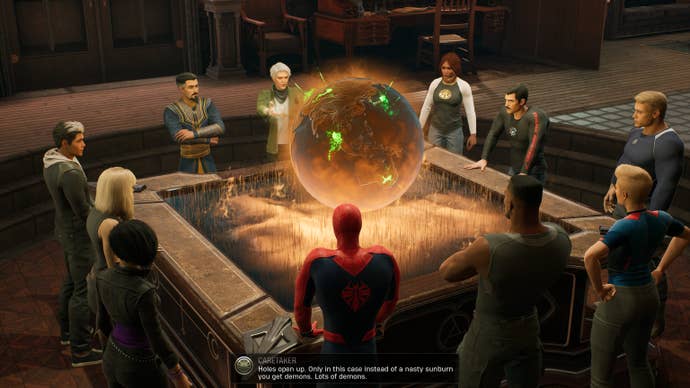
Then I’d do small things like designing their Abbey outfits, the clothes they wear.
That’s just like a personal hobby of mine!
[laughs] I haven’t been working nearly as hard as I did on the base game.
But yeah, I’ve been involved in the DLC.
I was doing play tests and things like that.
I was like, ‘Oh!’.
It felt very strange.
Do you enjoy meetings?
But it just seems so final.

At what point did you realise that it was time to move on?
What if I did this, what if I did that?
And I started to realise that’s no way to go into another big project.
I just started to feel like it was time for me to actually take a risk, I guess.
Your new ideas weren’t something you could have pitched to Firaxis?
Yeah, I could, I suppose I could.
They have the designers to do it.
They could do all of those things.
I think it just wouldn’t have been fair to everybody.

What life sims have you played over the years?
What is it about them that you enjoy?
There’s a number of things that appeal.
And I think the power of having the life that you want?
And then obviously, being able to experiment - like a playful… like a toy almost.
And that’s true for any sort of simulation-based game.
Simulations can really delight you, because they’re following these rules that sometimes are hidden from you.
And they can surprise you, and it just feels more authentic.
It feels like it’s following rules, but it feels like it can transport you in that way.
So that’s why simulation really appeals.
Is it those stories that emerge from within the simulation that get you fired up?
Yeah, I think that everything feels original, there’s a lot of procedural-ness to it, right?
And then everything feels original to you because it’s procedural.
And when it feels original, it feels authentic.
And it feels shareable.
That’s a good question.
I mean, it is interesting.
That is typically the way that I like to approach design.
The player knows what’s going to happen, and if you do this, you get that.
And I think that was even more evident in Midnight Suns.
We just tried to put as much information out there in front of the player as possible.
So I think maybe that’ll be the biggest challenge for me.
But in terms of gaming tastes, I’ve always liked simulation.
Because for me, I always tend to veer backwards.
I like the safety of putting the rules front and centre.
But it was very, very rewarding.
I love that part of Midnight Suns, and so that is actually really exciting to me.
Yeah, I think the best moments are the stories that are created.
It’s a number of systems interacting in ways that are surprising.
And that can happen in our game as you said before.
That’s as dramatic as any scripted narrative anybody can write.
Well, Paradox and Ron Humble just did areally neat [thing].
I mean, I thought that that take on that straight up life sim was unique.
It’s interesting to look at.
There’s a lot of village simulations, right?
So I don’t know if it’s pejorative yet but cosy games, right?
There’s a sim-ish nature to that even down to Stardew and things like that.
But definitely to me, I see an opportunity.
On Simon’s podcast, you pickedMinecraftas one of your five games.
What a cheap, cheap pick.
I don’t think it’s cheap at all.
All the forever games.
It would be a very profitable console.
In playing Minecraft with your kids, has that contributed to giving you the life sim itch?
I think simulation-style games are great at that.
And I think that Minecraft is a great example.
Just by playing the game, you end up with something that you’ve created.
We’re like, Yeah, I made a statue here.
I made a house here, whatever it is.
Just by playing a game, you end up with creation.
And then it’s such a powerful feeling.
People do like to express themselves.
Being able to do that through games, I think it’s like almost limitless potential.
Do you aspire to create a game that never ends?
I do, I do.
It’d be nice, because then I could, maybe I…
Although I probably would go crazy.
Like, yeah, I’m just still working on the same game 15 years later.
I don’t know if I could do that.
But I’d be willing to try because that probably means that it was successful.
Where did that idea come from?
That’s all very high-minded.
It sounds great - and it was - but we only got like 9-10 months into it.
And it was really, really difficult.
Just like the tech, to even get that coming close to that idea was pretty overwhelming.
Do you feel like the tech is in a better place to do that now?
Yeah, I really do.
And I’m like, ‘I guess I’ll never get to make Dusk properly!’
But even talking about it gets me excited about it.
But yeah, I think the tech is probably in a much better place now.
Were there any other challenges that you found in realising that idea aside from the tech?
Yeah, I think the design - coming up with the reason.
So people eventually will say, ‘All right, I don’t care about the game objectives.’
Just like Minecraft, you have survival.
Even Fortnite, with its creative mode.
I think that first you play the game, and you understand the rules.
I just want to create.'
That was giving me a trouble.
Do you feel that those thoughts have still been ticking away at the back of your mind?
Would you have a better idea now of how to make that game than you did back then?
That is a good question.
Somewhere deep in the recesses of my mind, some part of it is spinning on.
I think that you always feel like you know more over time.
I don’t know.
I think it is a tough challenge.
But I do think for a game like that, you have to have a pretty strong theme.
And then you have to have pretty strong mechanics that resonate with that theme.
The player starts playing the game, and then they go, ‘Okay’.
Now the community can support itself because you start seeing other people’s creations and they’re amazing.
But again, I don’t know.
How many variations of animals can you create where you feel this is completely unique and authentic to me?
It’s not as powerful, when I think about it, as like building in Minecraft.
Like XCOM is almost entirely mechanics, right?
The story is there, it’s great and serves a purpose.
In Midnight Suns, that wasn’t the case.
The narrative had a much stronger role.
And so it was different in the way that I thought about the characters.
It was personally very, very enjoyable for me to play in that toolbox.
Yeah, the team was larger, for sure.
The production team was great.
And thank goodness, like, the Marvel Games team was unbelievably great to work with.
They’re also passionate ‘What if?’
punch in people so they’re always up for whatever crazy ideas the team would come up with.
But yeah, the external partner, luckily, was positive.
They’re were definitely an add to our team in a big way.
And I think that those stories are more impactful, because you have ownership of them as a player.
You own that character, you own that story.
These two are best friends, and these two are lovers, and these two hate each other.
Those are the stories that are powerful and feel unique.
You’d be like, ‘I don’t know that this has much meaning for me.’
We’re like, ‘Oh, this is really cool.’
You also mentioned on the podcast that you did quite enjoy working with that larger team.
What was it about working with more people that you found appealing?
A bigger team like that, you’re obviously able to achieve more.
It was a very, very big game.
And again, there’s value in small games.
There’s value in all different kinds of games.
I really, really love the game the team made, because I love how long it was.
I love being able to lose myself.
I’ll tell you, it was tough when I had to play through the game over and over.
I used to be able to play through XCOM in a weekend.
I’d play XCOM every weekend, and then work on notes and stuff like that for the week.
But I did love being able to lose myself in a game like that.
So the team being able to create something that big, and with that much… That’s as long as a movie.
How many times do you think you have played it all the way through?
For Midnight Suns, maybe I played through maybe six to eight times all the way through.
I probably played the first 10 hours 100 times.
But then towards the end, you got to play through everything.
That took me… probably took me a year, year and a half to do.
Does it generate more ideas when you play it?
By that time, I tried to be very responsible as a creative director.
Because otherwise you’re just dumping work on people who were already overworked.
Production was great about that too.
That work doesn’t come out of nowhere.
We’re gonna have to give up this other thing.
But in that last year, it’s a case of there is no ‘but’.
Was there anything that you did cut that you wished you could have kept in?
Oh my gosh, I’m sure, let me think.
We cut like 30 conversations from the game, like 30 scenes.
I mean, we cut a ton because we realised this is just simply too much.
Number one, it’s too much for the team.
They already had so much that they were working on.
And two, for the player.
There a lot of these things that were not necessary conversations.
And so we ended up cutting, and this was in the last year [of development].
There was this concerted effort to say ‘What do we think can go?’
because the team needs breathing room.
They’re drowning under all this narrative we piled on them.
And so we said, ‘All right, any conversation, is it really necessary?’
The narrative director, we’re very close, but he still texts me angrily about it.
When you ship the game, you realise, ‘Oh, there’s plenty’.
There was so much there.
Yeah, tiny, it’s like start-up size.
How are you going to approach doing something much smaller?
It’s interesting, right?
I don’t know!
I’m just focusing on making the biggest best version of this game that we can.'
And you do it responsibly.
Oh, I’ll tell you where the money comes from.
I can tell you the person the money comes from.
So you think to yourself, what is truly essential to make a great game?
And I’m not even in that space yet.
I haven’t formed anything.
How much do dates matter?
Well, they always matter when you’re at the publisher.
How do dates matter when you’re a startup?
It really, really, really matters.
It’s like, ‘No, I don’t think so!’
So it’s a challenging environment, I think.
But again, I haven’t actually started that, that’s the way I’m seeing it.
Yeah, you said at the start that you’re just three days out of having just stopped working.
I mean, I’m at GDC, so I would tell you, ‘Yes, probably.’
I mean, my challenge is that I’m not great at not working.
Like it really is a thing where I love design.
I love thinking about design systems, I love thinking about any idea.
I’m gonna chew on it and chew on it and chew on it.
I just, I can’t not have that in my head.
On the flipside, I am unemployed.
It’s difficult to do that when you know there is no money coming in at this point.
But boo hoo, right?
I’m the one who made the choice.
I think it’s a case of, I don’t know - I’m always thinking.
Even if I was on vacation, the back of my mind is working.
It’s not in a way that takes away from the others around me.
Maybe I do need a vacation.
Listen to me, I sound miserable!
I’m truly a generally happy guy.
But yeah, maybe I should take a vacation.
See what that’s like.
But my passion for making games isn’t dimmed at all.
That was never the case.
I love that company.
I love the games we made there.
So I guess I’m good in that regard.
Well, then, maybe we should talk more.'
Nothing happens, there’s no handshake.
I mean, it’d be great if there are handshake deals on this stuff.
Then it’s, ‘Okay, well, let’s talk more at some point.’
So, I think that part’s difficult - the hurry up and wait stuff.
But it’s an interesting change.
Which heroes were you personally responsible for?
And I think people will be surprised to learn that there aren’t that many designers at Firaxis.
And so, we would be point designers.
So Joe Weinhoffer, he was point designer on one hero, I was point designer on another hero.
And then we had a designer Will, who was designer of all the mysteries around the Abbey.
And so we divided all that stuff up.
Magic was definitely my baby, as one of the heroes that I really worked on.
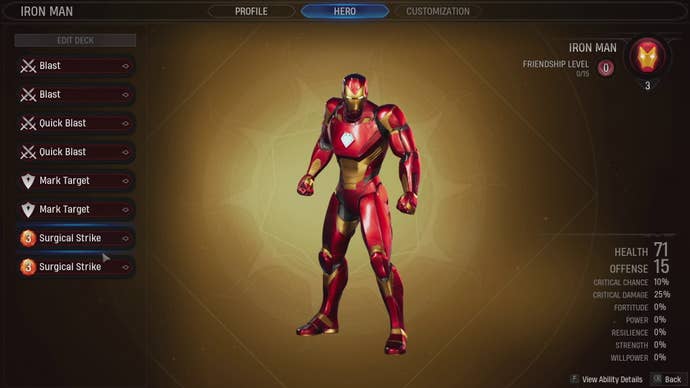
Joe was Spider Man and Doctor Strange, and I was Magic and Iron Man.
It would be bombastic.
It would be that every character is overpowered.
Because that’s poison.
If you’re never going to take this ability, it feels like it breaks the entire hero.
All the stats are so finely tuned and they’re brilliant at that.
Destiny, too, brilliant.
But they have less leeway in terms of their design.
They could score the heroes, and I guarantee they’d be way all over the place.
Because that’s not our focus.
I don’t care how it matches up on a very, very fine level.
you could’t break that.
The meta isn’t as important in a single player game.
I think that’s the thing.
Hah, that was wishful thinking for some people!
How did it feel to see that people were saying that about the game?
The biggest [thing of] interest for me was people being disappointed.
Before, I never had an experience where people had expressed disappointment before playing, you know.
I love this.'
Yes, it’s turn based tactics in combat, but there are no shared mechanics.
Are those… are those cards?
So yeah, I can sympathise with people for that reason, I guess.
If you did have the chance to work with Marvel again, would you take it?
I’m sure you could pitch them a Marvel life simulator.
That would be awesome!
[laughs] That would be actually great.
There’s got to be some version of that, right?
Where it’s just like the daily lives.
Because as fun as combat is, it’s even funnier to think of these heroes outside of combat.
Just like, I don’t know, are there any nuisances?
Would they be monsters?
Or would they just have the same problems as all of us?
Maybe… maybe a heroes life sim… All right, I’m taking it.
That’s my idea [laughs].
It’s tough to say.
There are two things.
One is introducing people to characters that I grew up loving as a child.
I think that was really, really fun.
I thought that was really cool.
I think that system feels different than anything else.
This feels new.'
That’s a really rewarding thing to do.
So that might be the thing I’m most proud of.
And what would you say you’re proudest of in XCOM?
I think I am most proud of the emergent narrative.
The emergent narrative stuff, specifically with the soldiers.
He’s got a ponytail and a Fedora.
I know I wouldn’t like this guy immediately.
But he’s a great ranger.'
I always like that, because that always made me giggle.
And then it was really fun to then see players love that stuff, too.
Thinking back to that very early XCOM prototype that you made -
Oh lord.
Because for 90% of the game’s life, it’s not good, right?
The worst thing in human nature is wishful thinking.
The idea that it’s going to be okay.
No, it’s not going to be okay.
You have to find the way to make it okay.
You must find what’s going to make it okay.
And the problem is that, as a designer, you did your best job!
You already put your best ideas in!
And then it comes back and it’s like, ‘This is not fun.’
You’re like, ‘Well, that was my best idea!’
And your brain will be like, this is too stressful.
Make a change, dude!'
Start with the first least fun thing and change it.
Even if that was your best idea, tough luck, dude!
So you get to a point where you don’t care anymore.
You almost can’t sleep at night because you’ve got to figure this thing out.
Because the stakes, especially in games nowadays, the stakes are as high as they could be.
What do you feel that XCOM’s legacy is now?
People just looked at it as a wacky idea.
It just seemed really, really different.
I think that was the first thing I’d done as a designer.
So it’s fun then to see people say, ‘Oh, no, that can totally work.’
And now there’s every version you’re free to think of with that.
That’s a really cool thing for the scrappy team that we were when we put that stuff together.
It’s a really… it’s a nice thing.
So many developers know that now.
So it’s neat.
But I guess thats how it happens.
Do you feel happy with the contribution that you have made to the genre?
Oh, for sure.
To some extent, I’m probably scared to ever touch it again.
You know, I’d be afraid to go back to that.
And I think that I’m really proud of what we did as a team.
I’m really proud of what I did individually.
I’m okay for those to stand.
I’m okay with that.
It would have to be good people, making great games.
You’re working on a not good product.
And nobody’s there to save you.
The team must save itself.
So good people making great games is I just think essential.
And I learned that from Firaxis.
There’s so many good people there.
