Hey, Ive got this far.
Lets see how far I can take it.
Oh yeah, weve got theSystem ShockIP, said the insurance company.

What do you want to do with it?
Do you want to make a sequel?
Up until that point, Kick had dedicated his life to creative pursuits.

He had no business background, and none of the acumen required to understand contracts or negotiate licensing fees.
More to the point, he had no more than $5,000 to his name.
Hardly the foundation for a follow-up to two of the most acclaimed PC games of all time.
Im in the middle of the jungle on satellite internet, he recalls now.
Its not really in my near future, you know?
And yet, finding himself at an existential crossroads, Kick pitched the insurance company on re-releasingSystem Shock 2.
And they said yes.
From then on, I felt like I had just jumped into the ocean, he says.
And it really ignited this passion for, Hey, Ive got this far.
Lets see how far I can take it.
It began in early 1999, as the snow and dark gathered in Massachusetts.
It was one of those perfect evenings, Kick recalls.
There was that cold feeling even though it was comfortable next to my computer.
Back then, Kick had developed a habit of playing games to the accompaniment of CDs on his boombox.
He cued up the industrial rock band Filter.
Theres this one song that came on while the Shodan reveal was happening, he says.
Ill never forget that.
The Curse Of Monkey Island.Full Throttle.
And I just kept getting error messages, he says.
All the little tricks that I could venture to get it to work didnt work.
So I went to GOG.com, because why wouldnt they have this?
Its one of the best games of all time.
And thats when I discovered that it was their number one wishlisted game.
That second dead end prompted another question: What happened to the rights?
Why cant they release this?
The trademark remained with Electronic Arts.
And so Kick found the insurer, and fired over an email using the contact form on their website.
It was only a day later that the companys general counsel got in touch to offer System Shock 3.
But legally speaking, the only way to secure that trademark was to use it.
Because theyre an insurance company.
Its an unlikely story, and the wider games industry initially treated it as such.
They didnt believe me, Kick says.
They actually said in the email that I was full of shit.
Because they had been trying to get this game for years.
Like, how does this kid just get it?
It felt like an interrogation, he says.
And immediately I was like, Oh my god, what did I just get into?
Thats where we gotThe 7th Guestand The 11th Hour, he says.
We didnt go so far that the formula would be unrecognisable, Kick says.
The labyrinthian level design, for one thing, is something that we wanted to maintain.
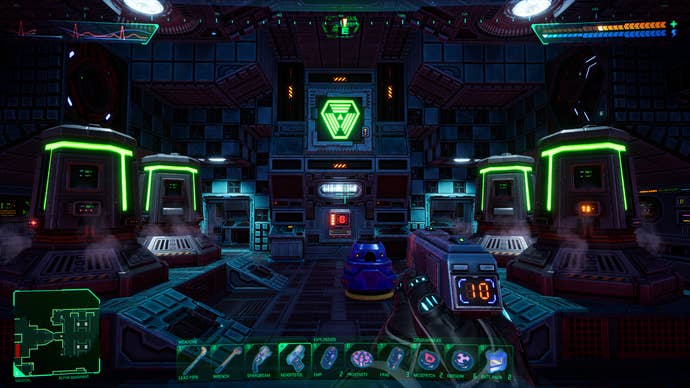
But the inventory management and the interactivity from System Shock 2 and Bioshock, we brought back.
Its a degree of granularity that the wider games industry has only recently begun to adopt.
That said, Nightdive eschewed many of the player safety nets of modern AAA productions.
You were probably going to need a piece of paper to write down door codes.
Weve already had a lot of people go, Where do I go, what do I do?
And its like, Well, were you even listening?
The characters tell you what to do, in a roundabout way.
Once again, System Shock is the axis upon which Kicks future turns.
But whatever the outcome, the companys guiding philosophy will continue.
I want people to make games that are influenced by our past, Kick says.
As far back as we can go.
And the only way we can do that is if we preserve them for people to play.
